Following some requests regarding my last post on punishment, asking me to talk a bit more about aversives, I’m sharing some excerpts from an ongoing project with you, giving you references for you to check, with the same request that you should not be limited to them and you must expand your research.
We know that the discussion around “aversives” in the dog world has become unusually polarized, and much of that polarization comes from how the term itself is being used. “Aversive” has become, in some discussions, a synonym for violence, harm, intimidation, or abuse, although academically it is not technically accurate. The behavioral sciences treat “aversive” as a functional concept, referring to what an event does to behavior rather than to the moral character of the person delivering it.
Aversiveness is a property of an interaction from the individual’s point of view because an aversive stimulus is defined as an event that an organism escapes, avoids, or works to terminate, and it is also the type of event whose onset can suppress a behavior (Pierce & Cheney, 2017). With this definition, aversiveness cannot be reduced to a short list of tools or methods, because it exists on a continuum and differs in intensity, duration, predictability, controllability, and learning history. For example, two dogs can experience the same event differently, and the same dog can experience it differently across contexts.
This is the first reason I disagree with the claim that “aversives equal harm”, because harm is a moral category that involves damage, injury, or long-term costs, and aversiveness is a functional category describing the role of an event in behavior. The two can overlap, and they sometimes do, but they are not interchangeable, and treating them as identical results in an inaccurate and poor level of discussion, resulting in some people ending up describing any uncomfortable moment as abuse, while others become defensive and pretend that discomfort never exists unless pain is involved, or discomfort is always necessary for learning.
Another oversimplification is to equate aversive control with punishment. I already wrote about it, so I just want to add that punishment is one possible form of aversive control, but negative reinforcement is equally important, and it appears constantly in everyday handling, even in training methods that explicitly reject punishment. Negative reinforcement refers to situations in which behavior increases because it results in the removal of an aversive condition. That is where I always like to mention Iwata’s “cold room” example, because it shows why real-world contingencies are complex. Iwata used the scenario of being in a cold room to exemplify how, sometimes, it can be difficult to distinguish between positive and negative reinforcement. Turning on a heater can be described as adding warmth, but it can also be described as removing cold, and either description can be technically correct depending on how you define the stimulus change (Iwata, 1987). The main point is that the organism’s behavior is strengthened because conditions improved, not because we divided the world into “added” versus “removed”. I see this example as relevant in dog training conversations, since people often argue about whether something counts as “an aversive” by debating labels rather than examining the functional relationship between behavior and consequence.
A functional approach also would make it easier to talk about a reality that there’s always hesitation to talk about. A degree of aversiveness is extremely difficult to eliminate entirely from interspecies communication. Even gentle interactions can contain a degree of constraint, interruption, prevention, delay, or loss of access. These are normal and inevitable elements of coordinated life with another species. A dog recalled away from something they were found interested in, asked to stop at a door, prevented from approaching another dog or person, or asked to leave from a highly preferred activity may experience mild frustration or mild stress in that behavior modification process, and the presence of mild stress does not prove that the interaction is harmful or unethical. Instead, it indicates that the individual is managing conflicting motivations and that the nervous system reacts to demands, uncertainty, and restriction, and we don’t need to give extreme (and mostly of the time unfitted) examples, as the situation matters, and predictable, controllable conditions typically reduce stress impact, while unpredictable or uncontrollable conditions tend to increase it (Fink, 2000; Tafet, 2022). These principles are easily identifiable in dog training, for instance, when a signal is delivered calmly, followed by reinforcement, but it can still create excess motivation if the context is overstimulating, uncertain, or the dog is already operating near its coping threshold.
And this brings us to a point that often surprises people, which is that procedures widely seen as “non-aversive” can still include aversive components, depending on how the individual experiences them. For instance, extinction, which refers to withholding reinforcement that previously maintained a behavior, can produce emotional responding, increased variability, and aggressive behavior patterns in some cases. The relevant ethical point is not that extinction is automatically “bad,” but that it is not neutral. Even in “reward-based” training, there are moments of denied access, delayed reinforcement, waiting, and the loss of expected consequences that can lead to a degree of frustration and stress for the individual, particularly when reinforcement has been frequent and predictable and then suddenly becomes unavailable.
This is why it is risky to treat “reward-based” as synonymous with “no aversives”. That statement may work as branding, but it does not follow the academic literature on this topic. Aversiveness is not limited to deliberate punishment, because it can also occur through the loss of opportunities, interruptions, increased task demands, and the emotional effects of violated expectations. A serious discussion here would not be whether aversiveness exists at all, but whether the aversive load is necessary, proportionate, predictable, and recoverable.
Another point I would like to mention is that punishment can suppress behavior quickly, but suppression is not the same as learning, and it carries predictable risks (Olson & Ramirez, 2020; Pierce & Cheney, 2017). But, at the same time, refusing to acknowledge aversiveness when it exists to a certain degree creates its own problem. Dogs do not need to “look terrified” to be under pressure. Early signs may include changes in latency, displacement behaviors, reduced exploration, altered play quality, or minor changes in the interaction that we sometimes see as an “improvement”. A vocabulary that treats every aversive as violence makes it hard to seriously talk about these subtle patterns, because people become afraid that naming aversiveness is equivalent to confessing abuse. Precise terminology helps because it separates description from condemnation, and some scientists could help bring these nuances and clarifications into future studies on dog training, instead of unconsciously (or not) promoting a biased and unclear view of aversiveness and punishment to avoid the online canine inquisition.
The dog world would also benefit from clearer definitions from the academic literature instead of popular rhetoric and slogans, because it would actually bring much more clarity and help any individual to see the difference between trainers who don’t have an idea of what they are doing or saying and trainers who follow adapted and diverse protocols of behavior modification. To be clear, an aversive is not the same as abusive, and discomfort is not the same as harm. Of course, these distinctions are not excuses for harsh training or a justification to defend methods or tools A or B, and it is beyond my control how people interpret and apply these concepts. I still have the utopia regarding using correct terminology so everyone knows what a term means when we mentioned, and, in this case, aversiveness would he treated as a functional property rather than a moral label, becmoing possible to do a responsible work that actually improves welfare, by reducing unnecessary pressure, improving predictability, increasing the dog’s sense of control, and building clean contingencies that do not depend on coercion.
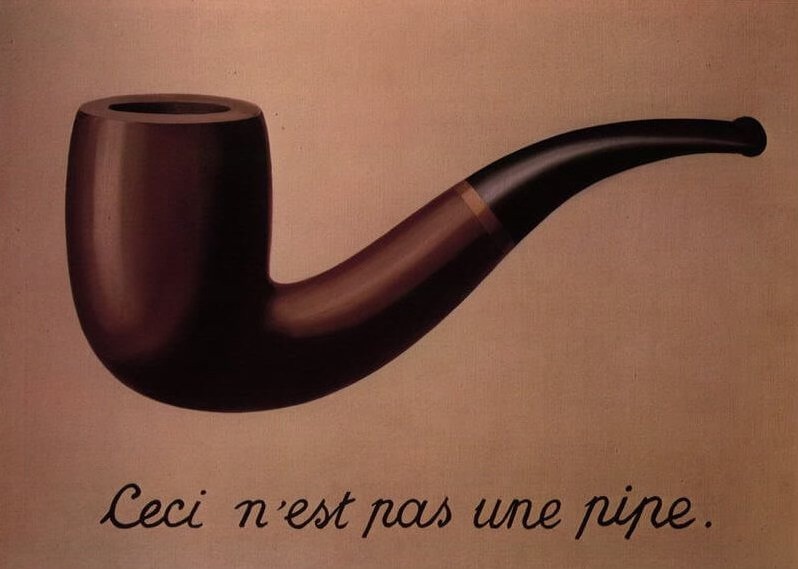
Image: René Magritte, The Treachery of Images (1929). A label is not the thing itself.
References
Fink, G. (2000). Encyclopedia of stress (Vols. 1–3). Academic Press.
Iwata B. A. (1987). Negative reinforcement in applied behavior analysis: an emerging technology. Journal of applied behavior analysis, 20(4), 361–378. https://doi.org/10.1901/jaba.1987.20-361
Olson, M., & Ramirez, J. (2020). An introduction to theories of learning (10th ed.). Routledge.
Pierce, W., & Cheney, C. (2017). Behavior analysis and learning: A biobehavioral approach (6th ed.). Routledge.
Tafet, G. (2022). Neuroscience of stress: From neurobiology to cognitive, emotional and behavioral sciences. Springer Nature Switzerland AG.
Ulrika Candolin, & Bob B.M. Wong. (2012). Behavioural Responses to a Changing World. Oxford University Press.
Comments are not enabled on posts. To discuss an author’s post, you can reply directly to the email you receive if you are subscribed, or contact the author directly by clicking here.